Gunpowder Girls by Tanya Anderson
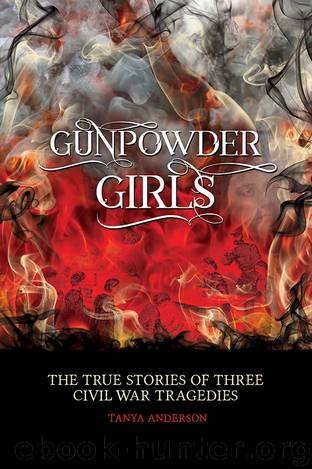
Author:Tanya Anderson [Anderson, Tanya]
Language: eng
Format: epub
ISBN: 978-0-9669258-4-5
Publisher: Quindaro Press
Published: 2016-10-01T04:00:00+00:00
Kate Horan felt the oppressive heat on Friday, June 17, but she also carried the normal daily sadness of leaving her four children: John, age 6; William, age 4; Joseph, age 2; and infant daughter, Mary. Kate was only 25 years old, but so much depended on her. She reminded herself of this every day when she looked at their little faces. Other girls and women were helping their widowed mothers by bringing in extra money. Some, like Sallie McElfresh, were only 12 years old. Kate, Sallie, and the others female workers made cartridges. They turned paper, gunpowder, and minié balls into lethal ammunition for the Union Army. No doubt, the cartridges they had made just days or weeks ago were now with the boys in Petersburg, Virginia.
Superintendent Tom Brown, age 47, had other things on his mind that day. The 4th of July was around the corner, and he needed to fill large orders for red and white “stars,” or flares, that the officers on the battlefield wanted so they could celebrate Independence Day with their boys. (The South did not celebrate Independence Day at all.) At any other time of year, the flares were not as high in demand because they were only used to illuminate an area during a night battle.
Brown called himself a pyrotechnist, even though he had no formal scientific training. Still, explosives were his specialty. Over the 23 years he had been working at the arsenal, Brown mixed powders and chemicals to make a variety of explosives. The Ordnance Department had a manual with specific formulas for each product, but Brown liked to play with the “recipes.” He felt he was making the mixtures safer than the ones the Ordnance Department recommended.
Brown was glad for the heat that day. Over the previous two weeks, daytime high temperatures had sometimes reached more than 100°F. His “stars” needed heat in order to dry. Brown mixed three ingredients—potassium chloride, strontium nitrate, and carbon—and formed them into gumball-sized nuggets. They were wet when first mixed, so he had devised a way to dry them, a method he had been using for a long time. He had three deep copper pans that had been painted black, because black absorbs heat. Brown placed 200 to 300 wet “stars” into each pan. Then he carried the pans outside to an area under some trees where no one usually walked, a place near the center of the arsenal compound where three buildings stood. He believed this was safe because it was unlikely anyone would jostle the pans and cause them to explode.
One of those nearby buildings was the laboratory where more than 100 women and girls worked — the building where Kate Horan and Sallie McEfresh worked.
Download
This site does not store any files on its server. We only index and link to content provided by other sites. Please contact the content providers to delete copyright contents if any and email us, we'll remove relevant links or contents immediately.
| Africa | Americas |
| Arctic & Antarctica | Asia |
| Australia & Oceania | Europe |
| Middle East | Russia |
| United States | World |
| Ancient Civilizations | Military |
| Historical Study & Educational Resources |
Cat's cradle by Kurt Vonnegut(15365)
Pimp by Iceberg Slim(14522)
4 3 2 1: A Novel by Paul Auster(12403)
Underground: A Human History of the Worlds Beneath Our Feet by Will Hunt(12101)
The Radium Girls by Kate Moore(12036)
Wiseguy by Nicholas Pileggi(5795)
The Fire Next Time by James Baldwin(5454)
Perfect Rhythm by Jae(5411)
American History Stories, Volume III (Yesterday's Classics) by Pratt Mara L(5312)
Paper Towns by Green John(5195)
Pale Blue Dot by Carl Sagan(5013)
A Higher Loyalty: Truth, Lies, and Leadership by James Comey(4966)
The Mayflower and the Pilgrims' New World by Nathaniel Philbrick(4508)
The Doomsday Machine by Daniel Ellsberg(4493)
Killers of the Flower Moon: The Osage Murders and the Birth of the FBI by David Grann(4451)
The Sympathizer by Viet Thanh Nguyen(4398)
Too Much and Not the Mood by Durga Chew-Bose(4353)
The Borden Murders by Sarah Miller(4330)
Sticky Fingers by Joe Hagan(4207)
